

Senator Elizabeth Warren became the subject of widespread attention in July 2025 after she fell backward on the U.S. Senate floor during an evening session. The unexpected moment was captured on video and quickly circulated online, turning a brief incident during routine congressional business into a widely discussed political news story.
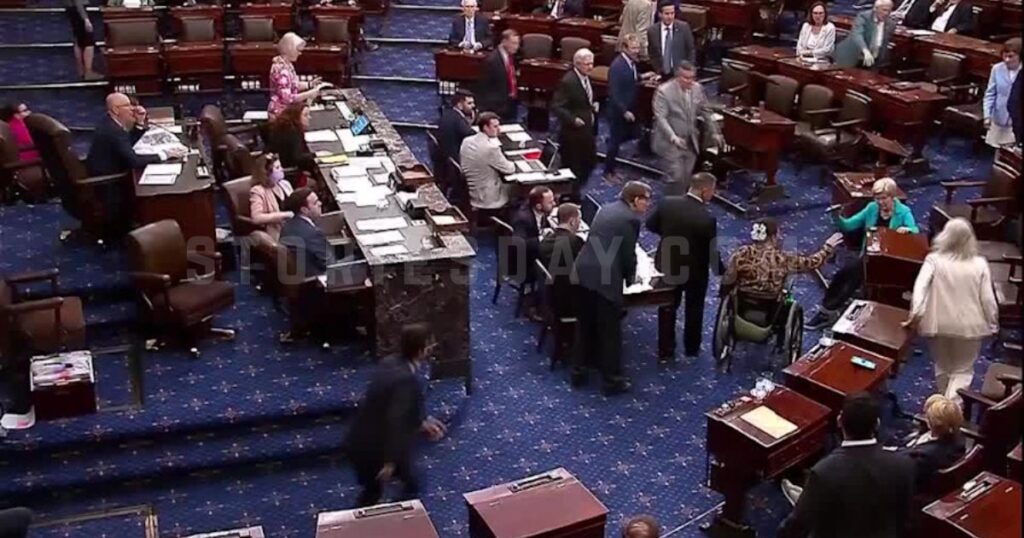
The fall happened on July 30, 2025, while the Senate was conducting a series of votes. Video showed Warren attempting to sit or lean against a small desk before the furniture tipped, sending her backward onto the floor. Republican senators, including Ted Cruz and Susan Collins, moved to help her. Contemporary reporting indicated that Warren appeared to be okay afterward.
The incident itself lasted only a few seconds, but the circumstances surrounding it made the moment especially notable. The Senate was considering resolutions concerning proposed U.S. arms sales to Israel, while also handling several nominations and other legislative matters.
Here is what happened, what the Senate was voting on, and why the footage attracted so much attention.
What Happened to Elizabeth Warren on the Senate Floor?
The incident was straightforward but unexpected.
During Senate proceedings on July 30, Warren was near a small desk when she appeared to lean back or attempt to sit on it. The desk tipped, and Warren fell backward onto the Senate floor along with the furniture. Video footage captured the entire moment.
Several senators reacted immediately.
Among those reported to have moved toward Warren were Republican senators Ted Cruz of Texas and Susan Collins of Maine. Their response created an unusual scene because the Senate had been engaged in contentious partisan debates that evening.
Rather than turning the incident into a political confrontation, the senators nearby focused on helping their colleague.
Warren was able to get back up and continued with the Senate’s business. Available reports did not indicate that she suffered a serious injury from the fall.
The video then spread rapidly across social media, where the incident was interpreted in very different ways depending on the political perspective of the viewer.
When Did the Fall Happen?
The fall occurred on Wednesday, July 30, 2025, during an evening Senate session.
Some news coverage published the following day referred to the event in connection with Thursday reporting dates, but the official Senate records establish July 30 as the date of the relevant proceedings and votes. The Senate’s own legislative records list the arms-sale votes at approximately 9:12 p.m. and 9:42 p.m. that evening.
The Senate remained busy well into the night.
According to the Senate Periodical Press Gallery, lawmakers considered several nominations and legislative matters before adjourning at 10:46 p.m. The two resolutions concerning arms sales to Israel were among the votes conducted during that session.
This timeline is important because it puts the viral video into its proper context. The incident did not happen during an isolated appearance or a campaign event. It occurred while the Senate was actively conducting official business.
What Was the Senate Voting On?
One of the main reasons the story received additional political attention was the subject of the Senate votes taking place around the same time.
The Senate considered two resolutions sponsored by Senator Bernie Sanders that sought congressional disapproval of proposed arms sales to Israel.
The first, S.J.Res. 41, concerned a proposed export of certain defense articles to Israel. The Senate considered a motion to discharge the resolution from the Foreign Relations Committee. That motion was rejected by a vote of 27–70.
The second, S.J.Res. 34, concerned congressional disapproval of another proposed foreign military sale to Israel involving defense articles and services. The Senate rejected the motion to discharge by 24–73.
Warren voted in favor of both motions.
The official records provide a more reliable picture than social-media posts because they show the actual vote totals, dates and individual voting positions.
The two resolutions did not advance.
The Senate also considered several nominations during the same session. The Periodical Press Gallery’s official summary shows votes involving nominees for positions including assistant attorney general, director of the National Counterterrorism Center, general counsel of the Department of Agriculture and director of the U.S. Marshals Service.
In other words, the viral incident happened in the middle of a particularly active Senate evening.
Who Helped Warren After the Fall?
The immediate response from other senators became one of the most talked-about aspects of the incident.
Reports identified Republican senators Ted Cruz and Susan Collins among those who moved to assist Warren after she fell.
The moment stood out because Warren and many Republican senators have significant political disagreements. Yet when she fell, the reaction inside the chamber was focused on her immediate well-being.
That does not mean the senators suddenly agreed on the political issues being debated.
Instead, it showed a basic human response to an unexpected accident. The contrast between partisan disagreement and personal assistance made the footage especially striking to viewers.
The episode also became an example of why short political clips can sometimes tell only part of a story. A viewer who saw the fall without context might not know that the senators who rushed toward Warren included lawmakers from the opposing party.
Was Elizabeth Warren Injured?
The available reporting indicated that Warren appeared to be okay after the fall.
Video showed her getting back up, while colleagues offered assistance. Contemporary coverage did not report a serious injury resulting from the incident.
That distinction is important when discussing viral footage.
An unexpected fall can look dramatic on video, but the footage alone cannot establish the extent of a person’s medical condition. Unless there is an official medical statement, it is better to describe what was visibly observed rather than speculate about injuries or health problems.
In Warren’s case, the observable facts are relatively clear: she fell, colleagues helped her, and she continued participating in Senate proceedings.
There is no need to turn a brief accident into an unsupported medical story.
Why Did the Video Become So Popular?
The footage had several qualities that made it highly shareable.
First, the event was completely unscripted. Political speeches, debates and votes are expected parts of Senate coverage, but an elected senator unexpectedly falling is not.
Second, the footage was easy to understand without much explanation. Viewers could immediately see Warren lean against the desk, watch it tip and then see her fall.
Third, Warren is a nationally recognized political figure. Because she has spent years at the center of major political debates, an unusual moment involving her naturally received more attention than an equivalent incident involving an unknown person.
Finally, the video appeared in an intensely partisan online environment.
Some viewers expressed concern, while others responded with jokes or political criticism. Several media reports focused not only on the fall itself but also on the reactions that followed online.
That second wave of commentary helped transform a brief Senate-floor mishap into a much larger news story.
The Political Context Behind the Moment
The phrase elizabeth warren falls on senate floor can make the incident sound like an isolated event, but the surrounding Senate business provides important context.
Earlier on July 30, Warren delivered remarks on the Senate floor about federal funding and congressional authority. Her office published the prepared remarks from that speech, in which she criticized Republican approaches to government funding and argued that Congress has an important constitutional role in determining how federal programs are funded.
Later that day, the Senate continued with votes and nominations.
The arms-sale resolutions sponsored by Sanders were particularly significant because they concerned U.S. military assistance to Israel. Both measures were rejected, but Warren voted in favor of both.
The fall therefore occurred during a busy period of legislative activity.
It is also important to separate the accident from the policy debate. Warren’s fall was not a political statement, nor was it related to the substance of the arms-sale resolutions. The two events simply occurred during the same Senate session.
What Were the Israel-Related Resolutions About?
Understanding the resolutions helps explain why the incident was reported in connection with an Israel-related Senate vote.
S.J.Res. 41 was introduced by Sanders on March 27, 2025. Its stated purpose was congressional disapproval of a proposed export of certain defense articles to Israel. The Senate rejected the motion to discharge the resolution from committee on July 30 by 27–70.
S.J.Res. 34 was introduced by Sanders on March 10, 2025. It sought congressional disapproval of a proposed foreign military sale to Israel involving certain defense articles and services. The Senate rejected the relevant motion by 24–73 on July 30.
These votes were part of a broader congressional debate over U.S. arms transfers to Israel during the war in Gaza.
Warren’s support for both resolutions is documented in the Senate’s official voting records. That provides a useful factual link between the senator and the proceedings without suggesting that the fall itself had anything to do with the legislation.
How the Incident Was Covered in the Media
Coverage varied depending on the publication.
Some outlets treated the story primarily as a straightforward news report. Their focus was on the fall, the tipped desk, the response from colleagues and Warren’s apparent recovery.
Other coverage emphasized the political reaction to the footage.
That distinction matters because headlines and commentary can shape how readers interpret the same event. A report emphasizing bipartisan assistance presents a different angle from one focusing primarily on online mockery or partisan reactions.
A balanced account should distinguish between the documented event and the opinions that followed it.
The documented facts are relatively limited:
- Warren fell backward on the Senate floor.
- A desk tipped during the incident.
- Colleagues moved to assist her.
- She appeared to recover.
- The incident occurred during a busy Senate session.
- The Senate was considering resolutions concerning proposed arms sales to Israel.
- Warren voted in favor of both Israel-related motions.
- Both motions were rejected.
Everything beyond those points should be clearly attributed to a source or presented as commentary rather than established fact.
Why the Bipartisan Response Stood Out
Perhaps the most human part of the story was the response from senators across party lines.
American politics is often presented through disagreements, campaign attacks and highly partisan debates. The Senate itself was dealing with controversial issues that evening.
Yet when Warren fell, nearby lawmakers reacted as colleagues first.
Ted Cruz and Susan Collins were among the Republicans reported to have helped Warren.
The scene became notable precisely because it contrasted with the political environment surrounding it.
That does not mean the disagreements between Warren and her Republican colleagues disappeared. It simply demonstrates that political opponents can still respond with concern when another person needs immediate assistance.
For many viewers, that human element was as memorable as the fall itself.
The Difference Between the Viral Clip and the Full Story
A short video can make a complicated event look simple.
Someone falls. People react. The clip ends.
But the complete story requires more context.
The incident happened during an evening Senate session that included multiple votes, including two resolutions involving proposed arms sales to Israel. Official Senate records establish the timing and results of those votes.
Warren had also spoken on the Senate floor earlier that day about government funding and congressional authority.
The Senate continued its work after the incident.
This wider perspective is important because viral political content often strips away everything except the most visually dramatic few seconds. Understanding the surrounding events helps readers distinguish between what actually happened and the commentary that developed afterward.
What the Official Record Adds
Official congressional sources are especially valuable for a story like this.
The Senate’s roll-call records show exactly when the relevant votes occurred and how lawmakers voted. For S.J.Res. 41, the vote took place at 9:12 p.m. on July 30, 2025, and the motion was rejected 27–70. For S.J.Res. 34, the vote took place at 9:42 p.m. and was rejected 24–73.
The Senate’s daily record also shows that the chamber continued voting on nominations and other matters later that evening, eventually adjourning at 10:46 p.m.
These records help establish the legislative setting without relying on speculation.
They also demonstrate why the story should be understood as a brief incident within a much larger night of Senate business.
Why a Factual Approach Matters
The online discussion surrounding Warren’s fall included humor, criticism and partisan commentary.
That reaction is part of the story because it explains why the footage continued circulating. However, it should not be confused with evidence about Warren’s health, political future or character.
A responsible article should avoid making claims that cannot be supported.
There is also little value in exaggerating the event. The fall was unexpected and visually dramatic, but the available reporting indicates that Warren appeared to recover and continue with her work.
The strongest account is therefore the simplest one: explain the incident, provide the legislative context, identify the senators who responded, and distinguish verified facts from online reaction.
Final Takeaway
The elizabeth warren falls on senate floor incident became a viral moment because it was unexpected, easily captured on video and involved a nationally prominent senator.
Warren fell backward after a small desk tipped while she was leaning against or attempting to sit on it during Senate proceedings on July 30, 2025. Republican colleagues, including Ted Cruz and Susan Collins, moved to assist her, and contemporary reporting indicated that she appeared to be okay afterward.
The incident happened during a particularly busy Senate session. Lawmakers were considering several nominations and legislative matters, including two Sanders-sponsored resolutions seeking congressional disapproval of proposed arms sales to Israel. Both motions were rejected, with votes of 27–70 and 24–73, respectively. Warren voted in favor of both.
Ultimately, the fall was a brief accident that became much larger online because of Warren’s public profile and the speed of political social media.
Looking beyond the viral clip provides a clearer picture: this was an unexpected moment during ordinary Senate business, followed by an immediate bipartisan effort to help a colleague. The political debates surrounding the session were significant, but the fall itself was simply an unscripted incident that briefly interrupted an otherwise busy night on Capitol Hill.
Frequently Asked Questions
When did Elizabeth Warren fall on the Senate floor?
Elizabeth Warren fell during Senate proceedings on July 30, 2025. The Senate’s official records confirm that the relevant votes took place that evening.
How did Elizabeth Warren fall?
Video showed Warren leaning against or attempting to sit on a small desk before the desk tipped and she fell backward onto the floor.
Was Elizabeth Warren seriously injured?
Contemporary reporting indicated that Warren appeared to be okay after the incident. She was able to get back up and continue participating in Senate business.
Who helped Elizabeth Warren after she fell?
Republican senators including Ted Cruz and Susan Collins were reported to have moved to assist Warren after the fall.
What was the Senate voting on when Warren fell?
The Senate was handling several matters that evening, including two Sanders-sponsored resolutions concerning proposed arms sales to Israel. Both motions to discharge the resolutions from committee were rejected.
